Arc Coating Processes Use Multiple Controls to Reduce Droplet Formation
Just another WordPress site
Press Release Disclaimer: This is a press release distributed through the XPR Media network. It has not been independently verified by our newsroom.

Dongguan, Guangdong, China – September 28, 2026
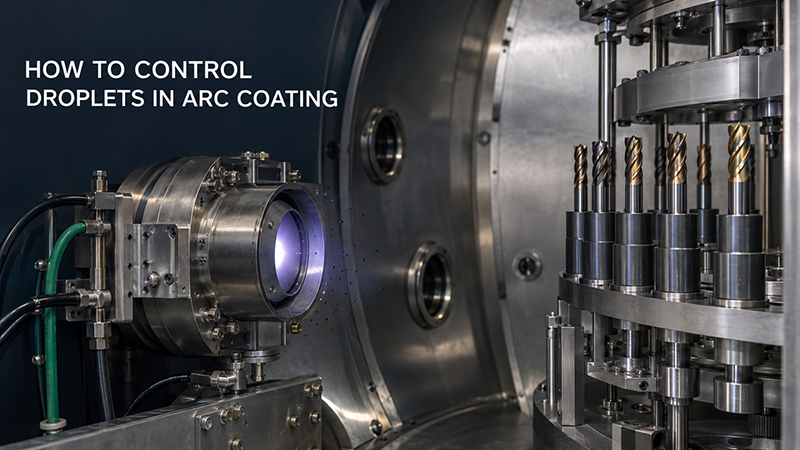
Arc coating provides high ionization, strong adhesion and efficient deposition, but the process can produce droplets, also called macroparticles. These raised particles increase surface roughness and may become local failure points on precision tools, molds and mechanical parts.
So, how do you control droplets in arc coating? The practical answer is to manage the complete deposition system. Cathode condition, arc-spot motion, current, magnetic field, source geometry, substrate movement and chamber cleanliness all affect the result. No single setting can remove every droplet.
Why Do Droplets Form?
In cathodic arc coating, the discharge is concentrated into small, fast-moving spots on the cathode. The intense local energy vaporizes and ionizes target material, while a small amount of molten material can be ejected as micrometre-scale droplets.
Droplet generation often increases when an arc spot remains in one area, the cathode overheats, the target is contaminated or the discharge becomes unstable. First confirm that the defects are really arc droplets. Flakes from chamber shields, dirty fixtures and particles left on poorly cleaned parts can look similar.
1. Control Arc-Spot Motion
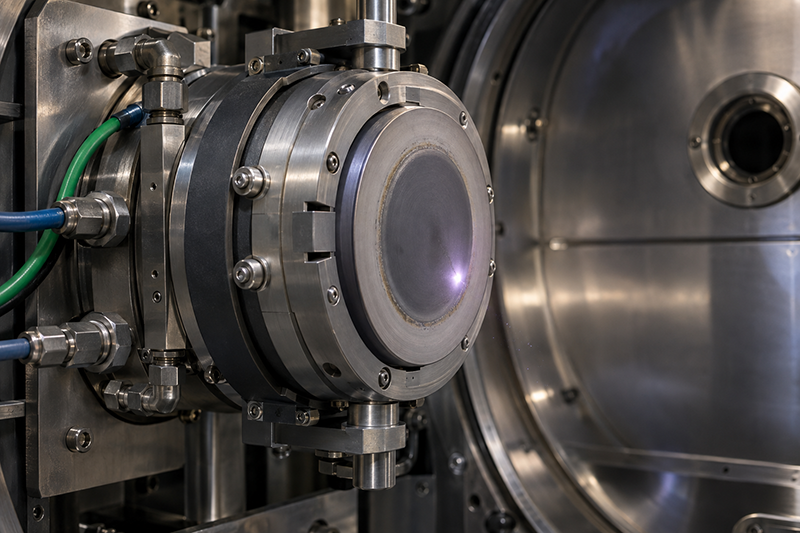
Magnetic steering is the first control point in an arc PVD coating process. A suitable magnetic field keeps the arc spot moving across the usable cathode surface, limiting prolonged local heating and large molten zones.
The magnetic setting must match the cathode material and reactive atmosphere. Slow movement may create deep pits and larger droplets, while an unsuitable field can drive the arc toward the cathode edge. Isolated burn marks, heavy edge erosion or uneven tracks indicate that the source needs adjustment.
2. Select a Stable Arc Current
Higher arc current increases plasma output and deposition rate, but also raises the cathode’s thermal load. Excessive current can increase droplet size or density. Reducing current too far is not a reliable fix because the arc may become unstable.
Effective arc coating droplet control uses a stable current window tested for the target material. Titanium, chromium and aluminium-containing cathodes may need different settings. Current, magnetic steering and cooling should be optimized together and saved as a controlled recipe.
3. Maintain the Cathode and Cooling System
Use dense, consistent cathodes with clean surfaces and secure thermal contact. Condition a new or exposed cathode with the shutter closed before coating production parts. This removes surface contamination and allows the arc track to stabilize.
Cooling-water flow and temperature also require routine checks. Poor cooling increases the cathode temperature and makes droplet formation harder to control. Include cathode assemblies, cooling channels and igniters in preventive maintenance.
4. Stabilize Pressure and Reactive-Gas Flow
Working pressure and reactive gases affect discharge behavior. Sudden changes in argon, nitrogen or hydrocarbon flow can disturb arc-spot motion. In reactive deposition, cathode poisoning may also change how the arc travels.
A repeatable arc ion plating recipe needs stable base pressure, controlled gas ramping and reliable feedback. Record actual curves for current, voltage, pressure and gas flow. A recipe name alone cannot prove that two batches ran under the same plasma conditions.
5. Block or Filter Ballistic Droplets
Many droplets follow a line-of-sight path. Shields, baffles and correctly positioned shutters can intercept part of the flux. Source angle and cathode-to-substrate distance can also reduce direct exposure, although excessive distance lowers deposition efficiency.
For smoother films, a filtered cathodic arc source can be considered. A curved magnetic duct guides charged plasma toward the substrate while many neutral or weakly charged macroparticles hit the filter wall. Filtration improves macroparticle control in PVD, but reduces plasma transmission and adds maintenance.
The application determines whether this trade-off is worthwhile. Cutting tools often prioritize adhesion, coating density and output, so a well-controlled conventional arc source may be suitable. Ultra-smooth molds, optical parts and some precision components may require filtration, HiPIMS or another process.
6. Optimize Rotation, Bias and Cleanliness
Planetary rotation improves thickness uniformity and distributes the remaining droplets more evenly, but it does not stop their formation. Substrate bias controls ion energy. A suitable pulsed bias can improve density and adhesion, while excessive bias may cause stress, overheating or re-sputtering. Because many droplets are not fully ionized, bias should not be treated as a direct filter.
Chamber maintenance is equally important. Thick deposits on shields and fixtures can crack during heating and cooling. Loose flakes then create defects larger than normal arc macroparticles. Cleaning intervals should follow deposited thickness and batch history.
How Should Droplet Control Be Verified?
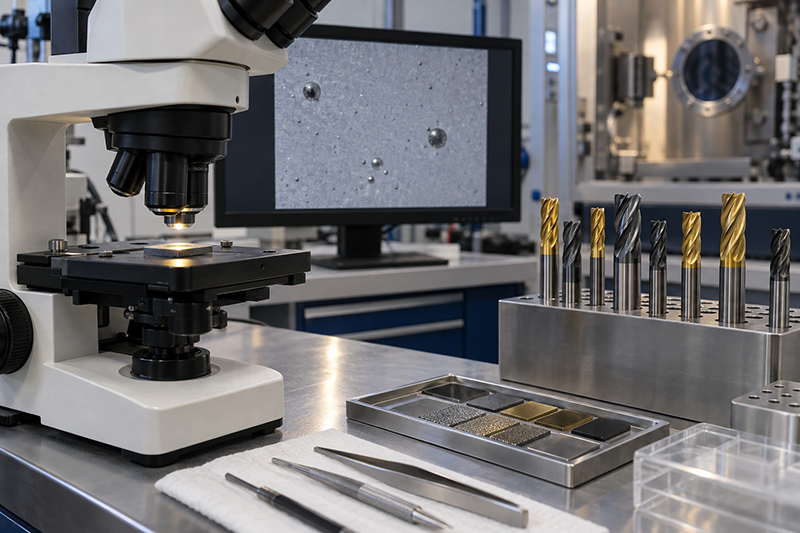
Place witness coupons at several positions in the load. Measure particle count by size range, surface roughness, coating thickness and adhesion. Optical microscopy supports routine checks; SEM and profilometry are useful for tighter specifications.
Change one parameter group at a time. Start with cathode condition and arc stability, then adjust magnetic steering and current. Evaluate geometry, rotation and bias after the source is stable.
When selecting an arc coating machine, define the acceptable roughness, part geometry, coating material and production target. Huasheng can configure AIP coating equipment around the application and use sample-coating trials to compare surface quality, adhesion and productivity. Very low-defect surfaces may also justify HiPIMS or a hybrid coating process.
Conclusion
Droplets are a natural result of cathodic arc evaporation, but their size, density and effect can be controlled. Stable magnetic steering, a suitable current window, effective cathode cooling, clean chamber hardware and correct part movement provide the strongest practical results.
The goal is a repeatable coating surface that meets the component’s roughness, adhesion, wear-life and production-cost requirements—not a “zero-droplet” claim without measurable acceptance criteria.
About Us
Founded in 2012, Huasheng is dedicated to the research, development, and manufacturing of industrial coating equipment. Our solutions cover PVD coating equipment, DLC coating equipment, diamond coating equipment, and hybrid coating systems, supporting a wide range of coating technologies including AIP, HiPIMS, PECVD, ta-C, and other advanced deposition processes.
Media Contact
Company Name: Guangdong HUASHENG Nanotechnology Co., Ltd.
Contact Person: Media Relations
Email: Send Email
Country: China
Website: https://www.hscoat.com/
Press Release Distributed by ABNewswire.com
To view the original version on ABNewswire visit: Arc Coating Processes Use Multiple Controls to Reduce Droplet Formation